
Ancient wisdom for modern goodmakers: St. Ethelburga
Ethelburga of Barking was a 7th century abbess whose name most people do not know.
She did not write theology. She did not preach to emperors or compose music or map the cosmos.
She cared for her people.
And when the Venerable Bede came to write about her, this is what he said:
"She was a true mother to the holy community."
For our work, that phrase is worth sitting with for a long time.
Not a visionary. Not a strategist. Not an innovator.
A true mother to the people in her care.
There is a kind of leadership that our world undervalues.
It does not announce itself.
It does not appear on the slide deck or the theory of change.
It does not show up easily in an impact report.
But you know when you have encountered it.
It is the leader who remembers what is happening in your life outside of work.
The founder who notices when something is wrong before you have said a word.
The director who creates the kind of culture where people can be honest, because honesty has always been safe there.
It is the kind of leadership that says, without ever needing to say it: I see you. Not just what you produce. You.
This is what Ethelburga built.
And when plague came to her community, and people began to die, it was this that sustained them. Not strategy. Not systems. But the quality of presence she had woven through the life of that place over years and years of faithful, attentive love.
Bede records that the dying sisters had visions. That light came to them. That even in their fear, something held them.
That does not happen by accident.
It is the fruit of a community where people have been genuinely known.
Where they have been seen all the way through.
Where the one who led them stayed close, and present, and true.
We talk a great deal in our work about vision and impact and scale.
These things matter. But Ethelburga asks a quieter and perhaps more searching question.
Do the people in your care know that you see them?
Not just their output. Their person.
Not just their role. Their life.
Not just what they bring to the mission. But who they are when the work is hard and the results are slow and they are wondering whether any of it is worth it.
That kind of seeing is costly.
It requires us to slow down enough to pay attention.
To resist the pull toward the urgent at the expense of the present.
To treat the culture we build as seriously as the programmes we deliver.
To understand, as Ethelburga seemed to, that the people are not the means to the mission.
The people are the point.
So as we go back to our work today, may we carry something of her with us.
Blessing
May we lead with presence as well as vision.
May we be the kind of people that others can be honest with, because they have learned that honesty is safe with us.
May we slow down enough to notice.
To ask the question that is not about the project.
To remember the name, the story, the thing that someone mentioned once and never thought we had heard.
May we build communities — in our organisations, our teams, our partnerships — where people feel genuinely seen. Where belonging is not conditional on performance. Where the culture itself becomes a form of care.
And may we receive that same gift ourselves.
May someone today see us — not just what we carry or what we produce, but us — and may we have the grace to let that be enough.
Go gently. Lead well. And know that the God who names the stars knows your name too.
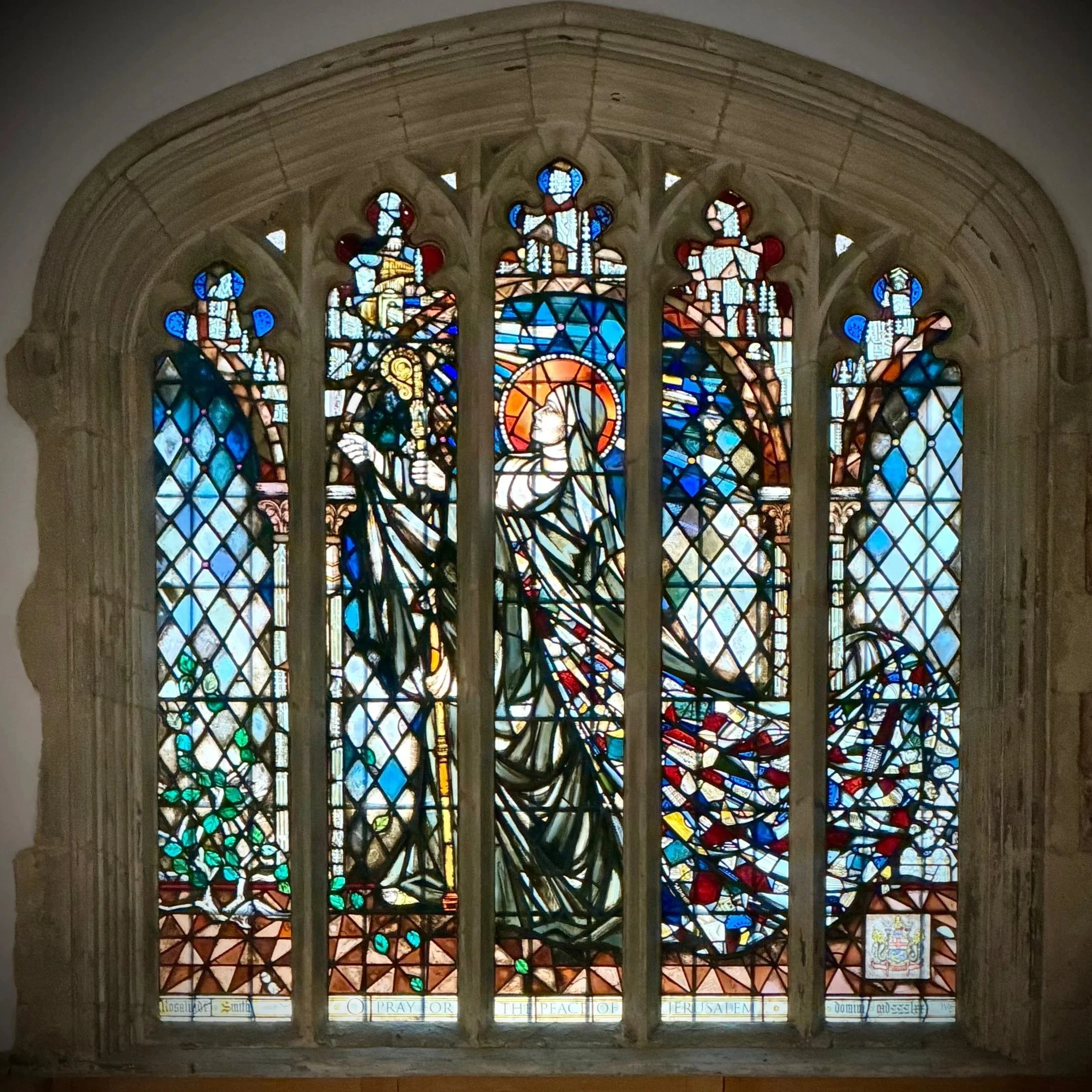
The Stained Glass Window of Ethleburga at St. Ethelburga’s Centre for Reconciliation and Peace.
In 1993 an IRA bomb exploded outside the church of St. Ethelburga, London.
“Each surviving fragment is placed the right way up, and where possible, in its original location. The composition of St. Ethelburga is carried through the five existing window lights and reflects the moving forward of Faith. The fragments of the previous window remind us of the tribulations of the past – but give us hope for the future.”
- Helen Whittaker, artist.